
Joe Turner’s Come and Gone a Powerful Work made Mesmerizing By a Great Cast at Penumbra

James Craven, Lester Purry, Vinecia Coleman, and Tonia Jackson Photo by Caroline Yang Photography

Joe Turner’s Come and Gone by celebrated playwright August Wilson. Strangely, this is the first stage production of August Wilson’s work I’ve seen. I have seen two film adaptations of his plays, Fences and Ma Rainey’s Black Bottom. I sure hope I get the opportunity to see more of his works produced. The Production runs nearly three hours, including the intermission, but it sure doesn’t feel like it. The audience sits mesmerized by the brilliant cast, unencumbered by any sense of the passage of time. And what a cast, one forgets that Nubia Monks is mentioned in the program until she appears for the final scene, of which I can only say it was worth the wait. It also says something about what a powerful and talented cast this show contains when you can afford to have Nubia Monks held back for what is almost a cameo appearance.

Joe Turner’s Come and Gone is set in the boarding house run by Seth Holly and his wife Bertha. As the play opens, we are introduced to the Hollys and one of their current residents, Bynum, a man whose activities include some strange spiritual practices. We also meet Selig, a white man, a peddler, who sells the pots and pans that Seth makes out of sheet metal. Selig, who travels all over, is known as a people finder, and Bynum has what he calls the power to bind people with his song. The only other tenant in the house as the play opens is Jeremy, a young man who works on the building of a new road outside of town. He is the character through whom we experience the systemic racism that pervades society at the time of the play, 1911.

Appearing mysteriously is a man in black, Herald Loomis, who is traveling with his young daughter Zonia in search of his wife, whom he hires Selig to find. Selig’s powers are easy to explain: he travels and keeps track of the people he meets and where they are. Bynum’s are another story. Act 1 ends with a very dramatic scene in which we must face the fact that there is definitely a spiritual element at work. The play, up until that scene, is for the most part a gentle show about people just getting by, filled with rich veins of humor and nuggets of wisdom. For the most part, the men provide the humor, and the women in the play, especially Bertha, provide the wisdom.

It is a post-slavery world that still deals with the repercussions of that appalling practice, including the barely disguised version practiced by the Joe Turner of the title, who used to capture Black men and enslave them. Herald Loomis, we learn, was one of Turner’s victims. The repercussions of which reverberate through the performance of La’Tevin Alexander, who plays Loomis, from the costume design, which makes him appear almost as a shadow, to his insistence that Zonia not leave the yard. There is a moment where he confesses he has forgotten how to touch a woman, that seems to drive home what has been taken from him.

There is a lot happening in this multilayered script. Each character is unique, yet shines a light on a past shared by many. It is ultimately about each person figuring out who they are and their path forward, about finding their song. Tonia Jackson, as Bertha, is wise and practical and tells it like it is. James Craven brings just the right amount of humor to the role of Seth without ever making him seem like comic relief; he just finds the humor in the pauses and the way he observes the people around him. Lester Purry, as Bynum, is calm and confident; he has found his song and now tries to guide others to theirs.

Lou Bellamy, the founder of Penumbra, directs the show with a clear understanding of the material and its characters. Everything runs so smoothly it feels not like watching characters in a play, but witnessing lives unfold.

Joe Turner’s Come and Gone runs through June 21st at Penumbra Center for Racial Healing in St. Paul. For more information and to purchase tickets, go to https://penumbratheatre.org/

ubscribe on a computer, enter your email address on the home page (right-hand side) and click subscribe. On mobile, scroll to the bottom of the page to find the same option. You can also follow me on Facebook @thestagesofmn and on Instagram thestagesofmn.

The Stages of MN YouTube channel is home to the Stages of MN Show. You can watch it by clicking here. Be sure to check out the latest episodes and subscribe so you’ll always know when a new one drops. Not sure you agree with one of my takes? I’m also part of the Twin Cities Theater Bloggers (TCTB), where you can find review roundups from my colleagues and me. Follow us on Facebook at @TwinCitiesTheaterBloggers.


The Most Happy Fella a Joyful and Moving Musical Bursting With Life From Ten Thousand Things

Suzie Juul and Pedro R. Bayón Photo by Glen Stubbe

“If there is one theater company in the Twin Cities that I trust enough to go into a show blind with zero reservations, it’s Ten Thousand Things (TTT). I knew nothing but the title and the cast when I stepped into the makeshift theater-in-the-round space at Hennepin Avenue United Methodist Church, one of almost two dozen venues in which they are performing The Most Happy Fella. Adapted into a musical by Frank Loesser in 1956 from a 1924 play named They Knew What They Wanted by Sidney Howard, it doesn’t feel 70 years old. I would not have been shocked to learn it was a new work. But then, that’s kinda what TTT does, they make whatever they are doing feel new. The best actors in the world, either for tragedy, comedy, history, pastoral, pastoral-comical, historical-pastoral, tragical-historical, tragical-comical-historical-pastoral, scene indivisible, or poem unlimited: Seneca cannot be too heavy, nor Plautus too light. For the law of writ and the liberty, these are the only men and women. Yeah, they give good Shakespeare too!

The Most Happy Fella opens in a restaurant at closing time in San Francisco. The two waitresses, Cleo and her friend, are commiserating over their aching feet, the lack of tips, and the lecherous boss they have to fend off. Cleo’s friend receives a jeweled tie pin as a tip, along with a note from a man named Tony, who, not knowing her name, calls her Rosabella and asks her to send him a postcard. The scene then jumps to four months later in the Napa Valley, on Tony’s grape farm, where he receives his latest letter from his Rosabella. She has sent him a photograph, and he prepares to send her one as well. The problem is she is a young and beautiful woman; he is a much older man who does not consider himself handsome. At the last minute, he switches his photo for one of his handsome young foreman, Joe. A little while later, she has agreed to marry him and is arriving on the train. Tony is frightened that she will be angry with him for his deceit. On the way to pick her up at the station, he has an accident and breaks his leg. Rosabella, at first, upon learning of the switch, is determined to leave before realizing that she has no money and no place to go back to, and so she agrees to marry the injured Tony. Tony senses she is unhappy and sends for her friend Cleo, offering her a job where she never has to stand again, so that Rosabella will have a friend.

Tony is played by Pedro R. Bayón as a man full of life and happiness who loses his way for a bit after the accident. With the guilt of his misrepresentation, he thinks he can finally see himself through Rosabella’s eyes and believes his dreams were absurd. What shines through is his innate kindness and genuine love for Rosabella, and as he convinces himself that she couldn’t love him, she begins to love him. Bayón is the heart and soul of the production, to be sure. Before the dawn, he experiences his darkest moments, but his heart and love win out over meaner emotions. It is a moment that brought this reviewer to tears, and I felt a genuine connection with Bayon’s Tony.

This is one of those casts where you cannot pick a favorite, as everyone is so good, and there are slightly too many in the cast to talk about them all individually. Several of the cast members also play instruments during the musical numbers under the music direction of Isabella Dawis. The music in this show seems to live in a space between opera and musical theater, though leaning heavily toward the musical theater end of that spectrum. At times, even though you are sitting in a large, brightly lit room in a church in Minneapolis, you swear you can almost smell the aroma of Italian dishes being prepared for the wedding banquet and feel the sun on your face, surrounded by Tony’s vineyard. Though the cast is only seven actors, it feels like you are part of this vibrant community, especially during songs like “Standing on the Corner” and “Abbondanza,” where the energy is joyful and bursting with life.

As TTT’s new Artistic Director and the Director of this show, Caitlin Lowans finishes her first season with this triumphant production. It’s the start of a new era for TTT, and I’m now entirely confident that all of these precious ten thousand things are in good hands. Joyful and moving doesn’t just describe this show, but this theater company itself.”—

A Most Happy Fella runs through June 7th at various locations around the Twin Cities. For more information such as locations and to purchase tickets go to https://tenthousandthings.org/

The Stages of MN delivered straight to your inbox. It’s the best way to make sure you never miss out on the theater action. To subscribe on a computer, enter your email address on the home page (right-hand side) and click subscribe. On mobile, scroll to the bottom of the page to find the same option. You can also follow me on Facebook @thestagesofmn and on Instagram thestagesofmn.

The Stages of MN YouTube channel is home to the Stages of MN Show. You can watch it by clicking here. Be sure to check out the latest episodes and subscribe so you’ll always know when a new one drops. Not sure you agree with one of my takes? I’m also part of the Twin Cities Theater Bloggers (TCTB), where you can find review roundups from my colleagues and me. Follow us on Facebook at @TwinCitiesTheaterBloggers.
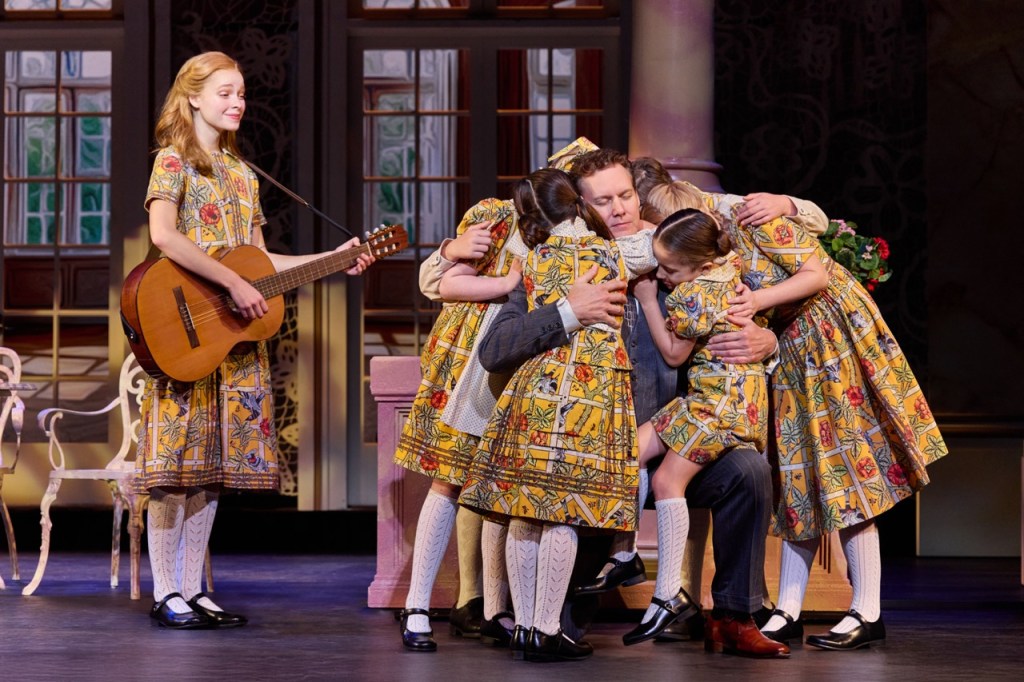
A Chorus Line Dazzles at Park Square Theatre

The Cast of A Chorus Line Photo by Dan Norman

Faithful readers will be aware of the group of performers my wife calls her “All Is Calm Boys”, anyone who has appeared in her favorite show, All Is Calm at Theater Latté Da. Well, I’ve decided I have my own version: the “Lizzie Quartet,” the four actors who performed last fall in Lizzie: The Rock Musical, Grace Hillmyer, Lux Mortenson, Abilene Olson, and Marley Ritchie. It’s been an excellent week on that front: I saw Lux Mortenson in Terce on Sunday at Theatre Elision, and now Marley Ritchie in A Chorus Line at Park Square Theatre. Both performances reinforced my feeling that I should make an effort to see everything they’re in.

If you missed Terce, you missed out, Sunday was its final performance, which is why I didn’t write a review. Don’t make the same mistake with A Chorus Line. Get tickets early in the run: they’ve been using multiple understudies at every performance and have already had to cancel one show. I’m not sure of the exact reason, but I suspect dance-related injuries play a role. Once you see the show, you’ll understand why.

Originally conceived, directed, and choreographed by Michael Bennett on Broadway in 1975, A Chorus Line is a physically demanding piece. Park Square has brought in Eddie Gutiérrez, representing the Michael Bennett Estate, to restage the original choreography, and it is intense and absolutely jaw-dropping. At one point, 19 dancers move in perfect synchronization, and it’s truly something to behold.

If you’re hesitant because you’re “not a dance person,” don’t let that stop you. This isn’t about Dance with a capital “D”, it’s about the dancers. And much of the choreography falls squarely into the crowd-pleasing category, the kind that even your farmer uncle would watch and say “Wow! That there is some perty fancy footwork, that was real neat fer sure!”. 

The show is set at an audition for the dance chorus of a new Broadway production. The Director and Choreographer, Zach, played by Stages of MN favorite Tyler Michaels King, must cut the field from 24 dancers down to eight. After an initial round, the group is reduced to 17, and Zach asks them to line up and tell him about themselves. Through these monologues and songs, we learn who they are, where they come from, what they’ve endured, and why they dance. Each story is distinct, and each adds another layer to the whole.

With 17 characters, it’s impossible to cover every performance in detail, but suffice it to say that everyone, including the five understudies performing at the show I attended, feels ideally cast. That includes Tyler Michaels King, who not only anchors the show but also joins the ensemble in song and dance at the beginning and end. We all know he is a fantastic singer and dancer. But the role also draws on his experiences as the Artistic Director of Trademark Theater and his work as a Director. I’ve seen him wearing those hats over the years and those experiences of running a room and giving notes, but also encouraging and being compassionate inform this performance.

Two performances stood out in particular. Steven Rada, as Paul, delivers a deeply moving turn. Paul is initially reluctant to open up, but when he finally does, while the others are on break, his story lands with emotional force. His eventual injury has a profound impact on the room, a stark reminder that a single moment can end a dancer’s career. It prompts Zach to ask the group what they would do if they could no longer dance, exposing a vulnerability that feels especially resonant in a time when the arts themselves are under attack. When theater’s like our beloved Jungle Theater, have to cancel productions. I’m sure for this group of performers, having just recently gone through the Covid era when theaters were shuttered, that the thought of what they would do if they couldn’t do this, feels very close to home.

Steven Rada Photo by Dan Norman

That moment leads directly into the show’s emotional peak: “What I Did for Love,” performed by Marley Ritchie, one of my “Lizzie Quartet,” in the role of Diana. Her rendition is stunning. It isn’t the dancing, as she plays it almost completely still, it is her vocals and acting that are completely captivating. Interestingly, when I looked back at the only other time I’ve seen a production of A Chorus Line, in 2023 at Lyric Arts, it was also Marley Ritchie that I singled out for her performance of this song.

Marley Ritchie Photo by Dan Norman

The show runs 2 hours and 8 minutes with no intermission, and evening performances begin at 7:00 p.m. rather than the customary 7:30, so plan accordingly. If you’ve never seen A Chorus Line, this is an excellent opportunity. If you have, I’d wager you haven’t seen it staged quite like this. Either way, don’t let it pass you by.

A Chorus Line runs through June 14 at Park Square Theatre in St. Paul. For more information and tickets go to https://www.parksquaretheatre.org/

The Stages of MN delivered straight to your inbox. It’s the best way to make sure you never miss out on the theater action. To subscribe on a computer, enter your email address on the home page (right-hand side) and click subscribe. On mobile, scroll to the bottom of the page to find the same option. You can also follow me on Facebook @thestagesofmn and on Instagram thestagesofmn.

The Stages of MN YouTube channel is home to the Stages of MN Show. You can watch it by clicking here. Be sure to check out the latest episodes and subscribe so you’ll always know when a new one drops. Not sure you agree with one of my takes? I’m also part of the Twin Cities Theater Bloggers (TCTB), where you can find review roundups from my colleagues and me. Follow us on Facebook at @TwinCitiesTheaterBloggers.

Courting Harry Looks at a Friendship Destroyed By the Supreme Court at History Theatre

Pearce Bunting, John Middleton, Bonni Allen, Jonathan Feld, EJ Subkoviak, Eva Gemlo Photo by Rick Spaulding

Courting Harry is my second show of the weekend dealing with constitutional law, which is an odd coincidence, right? Like What the Constitution Means to Me, this play has taken on new meaning in the short time since it premiered thirteen years ago. Several moments land differently now, particularly those dealing with Roe v. Wade, which has been overturned since the play’s debut. Another comes when Warren Burger comments on maintaining decorum and societal standards, things we’ve all watched erode over the past decade.

If you read my review of What the Constitution Means to Me and are worried I’m about to go off the deep end again, I promise I’ll try to stick to the production this time.

Courting Harry, by Lee Blessing, is adapted from Linda Greenhouse’s book on Supreme Court Justice Harry Blackmun. It focuses on his lifelong friendship with Warren Burger, whom he met in kindergarten in St. Paul. The two remained close for decades, but their relationship soured when they found themselves serving together on the Supreme Court, increasingly on opposite sides of the Court’s decisions.

Director Joel Sass, who also serves as set designer, as he often does at Open Eye Theatre, where he is the Artistic Director, stages the action in a kind of afterlife. Blackmun and Burger narrate the story in the first person, surrounded by shelves of bankers boxes containing everything Blackmun ever wrote. These boxes, which Greenhouse used as the basis for her book, become the source material for the play itself. From them, the two men pull notes, drafts, and letters, reconstructing, and arguing over, the details of their relationship.

It’s an engaging story about two kids from St. Paul who made good and went on to shape American society in profound ways. Pearce Bunting as Warren Burger and John Middleton as Harry Blackmun capture the rhythms of a lifelong friendship, the interruptions, the shorthand, the casual needling, and the deeper tensions underneath it all.

History Theatre once again makes history feel immediate and human by telling it through people rather than just facts. There’s a lingering sense that these men might have wished they’d chosen a different path, one that would have allowed them to remain friends. The play reminds us that Supreme Court justices are, first and foremost, people. They were once children; they have families and friendships; and like all of us, they have made, and lost, relationships over their beliefs.

Courting Harry runs through June 7th at the History Theatre in St. Paul. For more information and to purchase tickets go to https://www.historytheatre.com/2025-2026/courting-harry

The Stages of MN delivered straight to your inbox. It’s the best way to make sure you never miss out on the theater action. To subscribe on a computer, enter your email address on the home page (right-hand side) and click subscribe. On mobile, scroll to the bottom of the page to find the same option. You can also follow me on Facebook @thestagesofmn and on Instagram thestagesofmn.

The Stages of MN YouTube channel is home to the Stages of MN Show. You can watch it by clicking here. Be sure to check out the latest episodes and subscribe so you’ll always know when a new one drops. Not sure you agree with one of my takes? I’m also part of the Twin Cities Theater Bloggers (TCTB), where you can find review roundups from my colleagues and me. Follow us on Facebook at @TwinCitiesTheaterBloggers.
What the Constitution Means to Me is a Sobering Experience at Artistry

Mackynzie Ganbaatar and Stephanie Cousins Photo by Alyssa Kristine Photography

What the Constitution Means to Me is a relatively recent play, written, I imagine, in response to the first Trump administration by Heidi Schreck. In some ways, it’s a memory play, drawn from Schreck’s experience competing in constitutional debate competitions to earn college money. But as the piece progresses, the character of Schreck sheds her 15-year-old self, and the performance shifts into something more direct, more urgent, as she speaks as her adult self.

Much of the show focuses on women’s rights and abortion, but it also touches on immigration and broader questions of who the Constitution actually protects. Watching it now, it’s hard not to feel that if it were written today, it would go even further, because things have gone even further.

There’s a moderator, played here by Dan Hopman, and at the end the structure breaks open. The actor playing Schreck, Stephanie Cousins, drops the role, introduces herself, and brings out a local student debater. They argue whether the Constitution should be abolished, with an audience member serving as the final judge.

It’s sobering. It’s powerful. It’s deeply thought-provoking.

Or at least it was in 2018.

Now, with the benefit, or burden, of everything that’s happened since, it lands differently. Not while you’re watching it. Schreck’s script is laced with humor; it’s engaging, even disarming in the moment. The weight hits later, on the drive home, or when you sit with it. Or, in my case, when you’re asked to be the judge and actually decide.

Both sides make compelling arguments. But as I stood there considering them, I had a sinking realization: it doesn’t matter.

I used to think, naively, that our political divide was about different ideas of what’s best for the country. I was raised in the Christian faith, and thus I aligned myself with Democrats, as they are clearly the party of compassion. Even in high school, I couldn’t reconcile that with what I saw from Republicans. The hypocrisy was obvious to me at fourteen. I never understood how so many people couldn’t see it.

I understand now. People see what they want to see, especially when it gives them permission to believe or do terrible things.

But even after realizing that, I still believed there were guardrails. That the Constitution would ultimately protect us.

It took Trump, someone who doesn’t even pretend otherwise, to shatter that illusion. Someone who openly operates in his own self-interest, who uses power to enrich himself and those around him. A man with no moral compass, a convicted sexual assaulter, and worse. Someone who installs loyalists and media personalities into positions of power precisely because they will do what he says. Someone who, every time he speaks, demonstrates his disregard for the Constitution itself.

And nothing happens.

That’s the realization that settles in: the Constitution doesn’t protect us. It protects those who know how to manipulate it. Those who twist it. And when they can’t, they ignore it, and still, nothing happens. It becomes a tool to maintain power, not to check it.

So I voted to abolish it.

But even that feels futile. Because who writes the new Constitution? The same people who benefit from the current one. The same power structures. The same imbalance.

If this sounds like I didn’t like the show, that couldn’t be further from the truth. I loved it. I think everyone should see it.

But it forces you to think, and right now, thinking leads to some very dark places. Maybe this is just what it means to finally grow up politically: to recognize that the country doesn’t stand for what it claims to stand for. Maybe it never did. And when you see how many people continue to support all of this, it’s hard to believe it ever could.

I don’t know how you overcome that level of willful ignorance and/or evil.

And yet… if there is a way forward, it probably starts with exactly this kind of conversation. With work like this. With people sitting in a room together and actually engaging with these questions.

What the Constitution Means to Me runs through June 7 at Artistry in Bloomington. For more information and tickets go to https://artistrymn.org/constitution

The Stages of MN delivered straight to your inbox. It’s the best way to make sure you never miss out on the theater action. To subscribe on a computer, enter your email address on the home page (right-hand side) and click subscribe. On mobile, scroll to the bottom of the page to find the same option. You can also follow me on Facebook @thestagesofmn and on Instagram thestagesofmn.

The Stages of MN YouTube channel is home to the Stages of MN Show. You can watch it by clicking here. Be sure to check out the latest episodes and subscribe so you’ll always know when a new one drops. Not sure you agree with one of my takes? I’m also part of the Twin Cities Theater Bloggers (TCTB), where you can find review roundups from my colleagues and me. Follow us on Facebook at @TwinCitiesTheaterBloggers.

Once Upon a Mattress is a Beautiful Thing When Performed By Unlabeled Theatre Co.

Rachel Moquist and Mason Green (foreground) Natalie McComas and Adam Arnold (shadow Partners) Photo by Jordan Buckellew / JoyByJo.com

Faithful readers will know that I reviewed Once Upon a Mattress just under three weeks ago at Lakeshore Players, and I wasn’t overly enthusiastic about it. So why would I sit through it again so soon?

Because it’s being mounted by one of my favorite theater companies, Unlabeled Theatre Co.

This company exists to create opportunities for adults with disabilities to participate in theater. Every role is performed by an actor with a cognitive and/or physical disability or who is neurodivergent, paired with a neurotypical Shadow Partner. Together, the two performers share the role, performing it in unison. It sounds like it shouldn’t work, but it absolutely does, and it’s beautiful.

My chief concern with the Lakeshore Players production was the source material, which I found unfocused and nearly three hours long with an intermission. The first thing this production does right is cut the show down to a sharp, focused 70 minutes with no intermission. Gone is all the extraneous business, none of it missed. Unlabeled’s production hits all the key plot points, makes the story much easier to follow, and still includes all the best songs. About the only thing I missed was some comic business between the Queen and her son that helps clarify her motivations.

The plot adapts the familiar fairy tale of The Princess and the Pea, told in a fractured fairy tale style. In this kingdom, no one can marry until the Prince does. His mother, the Queen, devises such diabolical tests that every princess fails, largely because she has an unhealthily close relationship with her son and doesn’t actually want him to marry. Among those desperate to find the Prince a bride are Sir Harry and the pregnant Lady Larkin. Sir Harry ventures over the mountains and through the woods, not to Grandmother’s house, but to the swampy kingdom of the Marshlands and returns with Princess Winnifred, setting the Queen’s test in motion.

The cast is terrific and received a boisterous, well-deserved standing ovation. We often focus on our own enjoyment of a show, which is important, of course. But in a production like this, what stands out first is how much the cast is enjoying themselves, and that joy is infectious. It made the evening even more rewarding, if that’s possible. I can only imagine the pride the Shadow Partners feel watching their partners rise to the occasion and fully realize their potential as performers and storytellers. There may not be a more fulfilling acting experience in the Twin Cities.

Attending an Unlabeled Theatre Co. production feels like receiving a gift, a rare and meaningful one. It reminds us of the true power of theater: not just to entertain or instruct, but to create, to connect, and to share joy. You can’t watch this cast without recognizing the value of inclusivity and the sense of purpose these actors bring, not just in performing, but in performing well. They are fulfilling that deeply human need to tell stories and to foster empathy.

In a world where it can be hard to understand how people can remain unmoved by cruelty or contradiction, experiences like this matter. If anything can shift perspective, even just a little, it might be something like this: an honest, joyful, inclusive act of storytelling.

The last Unlabeled Theatre production sold out its entire run, and tonight’s performance had only a handful of empty seats. Get your tickets now, this is the kind of show that can restore your faith in humanity.

Once Upon a Mattress runs through May 24th at the Gremlin Theatre in St. Paul. For more information and tickets, visit https://unlabeledtheatre.org/

The Stages of MN delivered straight to your inbox. It’s the best way to make sure you never miss out on the theater action. To subscribe on a computer, enter your email address on the home page (right-hand side) and click subscribe. On mobile, scroll to the bottom of the page to find the same option. You can also follow me on Facebook @thestagesofmn and on Instagram thestagesofmn.

Fefu and Her Friends an Intimate Site Specific Play Staged by Theatre Pro Rata at the Searle Mansion Feels Like Eavesdropping

Christy Johnson, Brettina Davis, Jessica Winingham Photo by: Alex Wohlhueter

Fefu and Her Friends really feels as if you’re eavesdropping on a gathering of friends at the spacious country home of Fefu, played with breezy naturalism by Jessica Winingham. It’s set in the 1930s but written in the 1970s. The characters dress and observe the customs of the earlier era, but much of their behavior reflects the playwright’s feminist perspective. The result feels like a glimpse into how people might have actually behaved outside of literature and film, how longtime friends really spoke to one another and the emotions they allowed themselves to express.

Everything about this production, from the setting to the performances, works to be anti-theatrical, breaking down the barrier between actor and audience. Not through participation (there’s none of that), but through proximity. The audience follows the performers throughout the beautiful Searle Mansion on Lake of the Isles in Minneapolis. Without the usual dividing line between stage and house, the sense of “performance” all but disappears. The actors don’t need to project or exaggerate; we’re sitting close enough to touch them. The result feels more like film acting, subtle, intimate, and immersive.

There isn’t much of a traditional plot, and for once, that doesn’t feel like a drawback. The women have gathered to prepare for a fundraising event, but that’s largely incidental. Instead, we get fragments of conversation, glimpses of relationships, and small revelations. One of the more unusual elements is the character of Julia, whose empathy for animals takes on a surreal and tragic dimension.

The structure is as unconventional as the storytelling. The entire piece runs about 90 minutes. Act One, roughly 25 minutes, unfolds in the living room, introducing the characters. For Act Two, the audience is divided into four groups, each led to a different room in the mansion to watch a short scene. After eight or nine minutes, groups rotate to another room and another scene, until all have been seen. The audience then reconvenes in the living room for a final act of about 25 minutes.

A lot happens in that short span, and yet, in another sense, very little does. M’colleague Jill from Cherry and Spoon remarked that she’d happily watch a 10-episode Netflix series about these characters, which perfectly captures the experience. You’re drawn in not by plot, but by the people themselves. You simply want to spend more time with them. Listening to them talk is the point, and it’s consistently fascinating.

The performances are wonderfully unmannered across the board, and those that lean more theatrical feel intentionally so. Jessica Winingham is excellent as Fefu, evoking a grounded, realistic version of a 1930s screwball heroine. Equally compelling are the quiet interactions between Brettina Davis and Christy Johnson as Cindy and Christina, with Johnson earning a lovely laugh for her character’s peculiar method of drinking, placing a few drops of alcohol on an ice cube and sucking on it.

It’s also nice to see Nora Sonneborn again, though I’ll go on record saying she should be required to sing in every role going forward. As always, great to see Nissa Nordland, and I have to share this revelation I had about her. Though it has nothing to do with her performance in this role, other than the time period, costume, and her hair style. I was suddenly struck with the certainty that in 20 years time, though she’ll still be too young for the role, but with makeup could pull it off, she needs to play Agatha Christie’s Miss Marple. I think some company needs to do an annual Miss Marple play and cast her every year, it’ll be a tradition. She has the slightness of frame, the bird-like profile, that intelligent twinkle in her eye. It’s one of those things, where now that I’ve seen it I’ll never be able to unsee it. 

Fefu and Her Friends has an unusual schedule:

May 11, 7:30 PM – Opening Night, Mobility Access Night
May 12, 7:30 PM – Pay What You Can
May 13, 7:30 PM

May 18, 7:30 PM – Pay What You Can, Mobility Access Night, ASL, Audio Description
May 19, 7:30 PM
May 20, 7:30 PM

May 26, 7:30 PM
May 27, 7:30 PM
May 28, 7:30 PM – Closing Performance

For more information and tickets, visit https://www.theatreprorata.org/production-history/fefu-and-her-friends

The Stages of MN delivered straight to your inbox. It’s the best way to make sure you never miss out on the theater action. To subscribe on a computer, enter your email address on the home page (right-hand side) and click subscribe. On mobile, scroll to the bottom of the page to find the same option. You can also follow me on Facebook @thestagesofmn and on Instagram thestagesofmn.

The Stages of MN YouTube channel is home to the Stages of MN Show. You can watch it by clicking here. Be sure to check out the latest episodes and subscribe so you’ll always know when a new one drops. Not sure you agree with one of my takes? I’m also part of the Twin Cities Theater Bloggers (TCTB), where you can find review roundups from my colleagues and me. Follow us on Facebook at @TwinCitiesTheaterBloggers.